
Before You Redesign Your Website, Make These Decisions

Website redesign planning should begin before you choose a template, font, photograph, or button color. A redesign often starts with, “I just need it to look more professional,” which sounds simple until the project discovers nobody has decided what the website is actually supposed to do.
Three weeks later, you’re comparing templates, debating button styles, hunting for photographs, and discovering that the homepage message is being held together by temporary copy and optimism.
The old website may not have been the only problem. Sometimes it was simply the place where all the undecided business questions went to become visible.
Design can organize a clear decision. It cannot make the decision for the business.
What should website redesign planning include?
Clarify the site’s business goal, priority audiences, offers, messaging, proof, customer journeys, content responsibilities, calls to action, technical requirements, and measures before design begins. That sounds like a lot because it is the actual work.
Otherwise, the project becomes a prettier version of the same confusion, now with softer corners and a tasteful hover effect.
Decide what the website must accomplish
Is the site meant to generate inquiries, sell products, book appointments, attract donors, recruit volunteers, support referrals, explain a complex service, or do something else? “All of the above” is not a strategy. It is a group project without a leader.
A site can support several goals, but one or two should drive the structure. “Look professional” is an expectation, not a complete objective. So is “make it pop,” which remains bravely meaningless across industries.
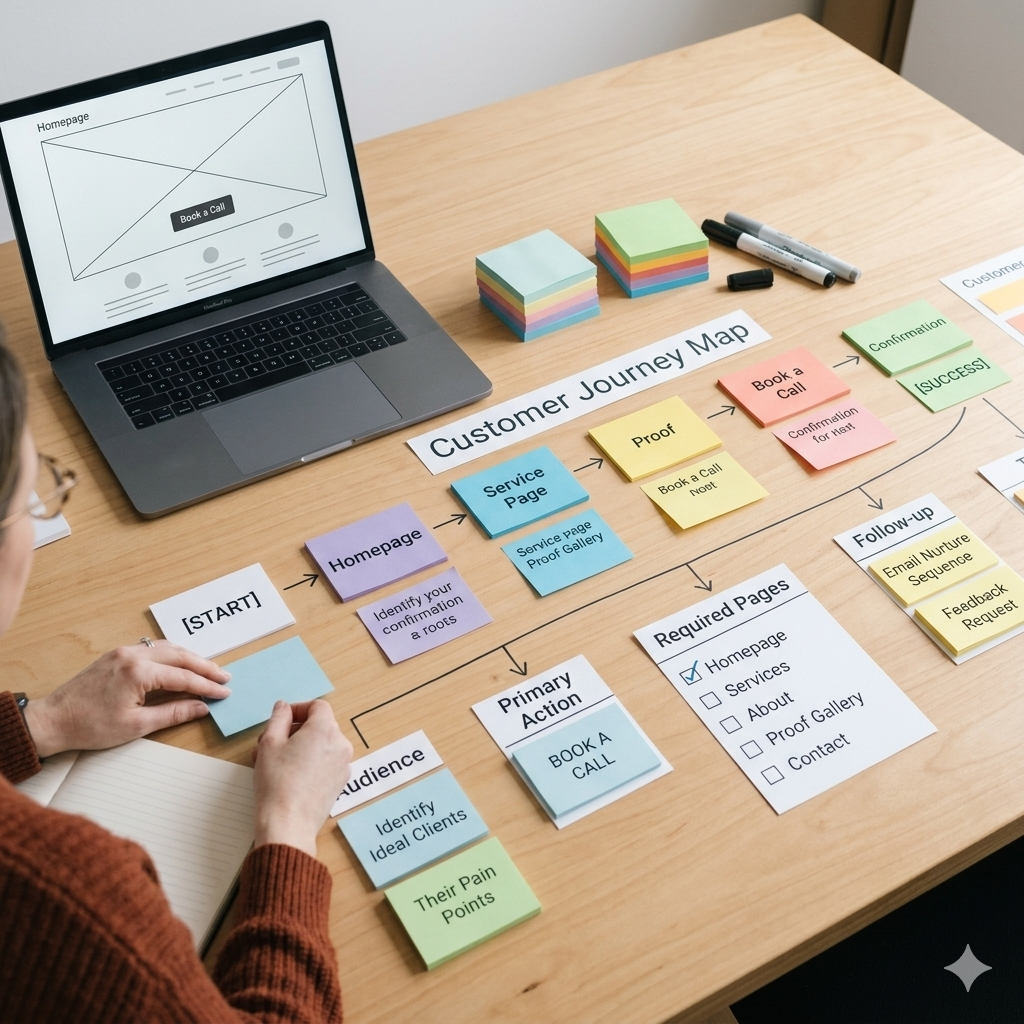

Good website redesign planning maps what customers need to understand, where they need to go, and what should happen next. The website is only one part of the journey.
Choose the priority audience
Who most needs to understand the site right now? What do they already know? What are they worried about? What evidence will help them trust the business? A website cannot speak to everyone with equal force without eventually sounding like it is addressing the entire airport terminal.
A new customer, existing client, referral partner, donor, job applicant, and media contact may all visit. They do not all deserve equal control of the homepage. Some of them can use the menu like grown-ups.
Clarify the offers before writing pages
If service names, scope, pricing logic, or starting points are still changing, the website project will keep restarting. Every design decision depends on what the business is asking people to understand and choose. The page cannot settle an argument the offer has not finished having.
Finalize the primary offer path first. Then build the page structure around it.
Write the message before choosing the layout
Templates contain spaces for words. They do not decide which words will help a customer understand the value. A lovely three-column section is not a positioning strategy, no matter how beautifully the icons line up.
Clarify the positioning, customer problem, outcome, differentiators, proof, and call to action before falling in love with a layout that requires exactly seven words and one suspiciously cheerful stock photo.
Gather proof early
Collect testimonials, reviews, relevant experience, certifications, case studies, portfolio examples, process details, partnerships, and policies before design begins. Proof is not a garnish to be added after the site is already plated.
Proof often affects the structure. Discovering it two days before launch usually produces a lonely testimonial slider and at least one late-night message titled “QUICK QUESTION.”
Map the customer journey
For each priority audience, identify how they arrive, what they need to understand, which page supports the decision, what action they take, and what happens after. The customer journey does not end when the button turns coral.
The redesign is not finished when the button works. The inquiry confirmation, scheduling process, purchase email, donation receipt, or follow-up also shapes whether the whole experience feels trustworthy or like the website handed the customer into a dark hallway.
Audit what can stay
A redesign does not require throwing away every useful page. Review current traffic, search performance, links, conversions, and customer feedback before deleting URLs with the confidence of someone clearing a junk drawer after midnight.
Preserve valuable URLs when possible or create proper redirects. Google’s Search Essentials recommend crawlable links and helpful, people-first content; a redesign should improve understanding without casually erasing pages search engines and customers already use.
Assign content ownership
Who writes, reviews, approves, uploads, and maintains each page? What information is missing? Which photographs or documents need to be created?
“We’ll figure out the copy later” is how a six-week website becomes a seasonal relationship.
Define technical requirements
List forms, booking, payments, ecommerce, email signup, analytics, CRM connections, accessibility, legal policies, security, search, filtering, and integrations before selecting the platform or template. Discovering a required feature after design is complete tends to create invoice-shaped feelings.
The prettiest option is not useful if it cannot support the business without duct tape and a monthly plugin prayer circle.
Decide how success will be measured
Track actions connected to the goal: qualified inquiries, bookings, purchases, donations, signups, downloads, calls, or completed forms. Add analytics and conversion tracking before launch so success does not become “people said it looked nice.”
A redesign should solve a business problem, not merely produce a reveal post with excellent music.
Redesign, refresh, or repair?
You may not need a full rebuild. A focused refresh can be enough when the platform works, structure is sound, and the main problems involve copy, imagery, proof, or a few confusing paths. Not every website needs demolition. Some need the equivalent of moving the furniture and finally labeling the doors.
A redesign is more appropriate when the structure, technology, accessibility, mobile experience, brand, content model, or business strategy has materially changed.
Good website redesign planning clarifies the business decisions that design will need to communicate. It is less glamorous than choosing fonts and considerably more likely to keep the project from eating the calendar.
Frequently asked questions
What content do I need before a website redesign? Prepare audience and offer information, page goals, core messaging, proof, service details, FAQs, calls to action, images, policies, and contact or booking information.
Should I hire a designer before a copywriter or strategist? When positioning, offers, or customer journeys are unclear, strategy and copy should begin before or alongside design. The disciplines work best collaboratively.
How long should a website redesign take? Timing depends on scope, platform, content readiness, integrations, feedback, and approvals. Missing decisions and delayed content often create more delay than the design itself.
Will a redesign improve SEO automatically? No. Search performance depends on technical setup, useful content, page structure, links, intent match, authority, and preserving or redirecting valuable URLs.
Your next right step
Before opening another template demo, write a one-page website brief: goal, priority audience, main offer, key message, proof, primary action, required pages, and technical needs. Then ask whether the current plan can answer those questions without whispering, “We’ll figure it out later.”
Planning a site that needs more than a cosmetic refresh?
Explore the Visibility Roadmap and Olive & Lumen’s website and marketing strategy support.